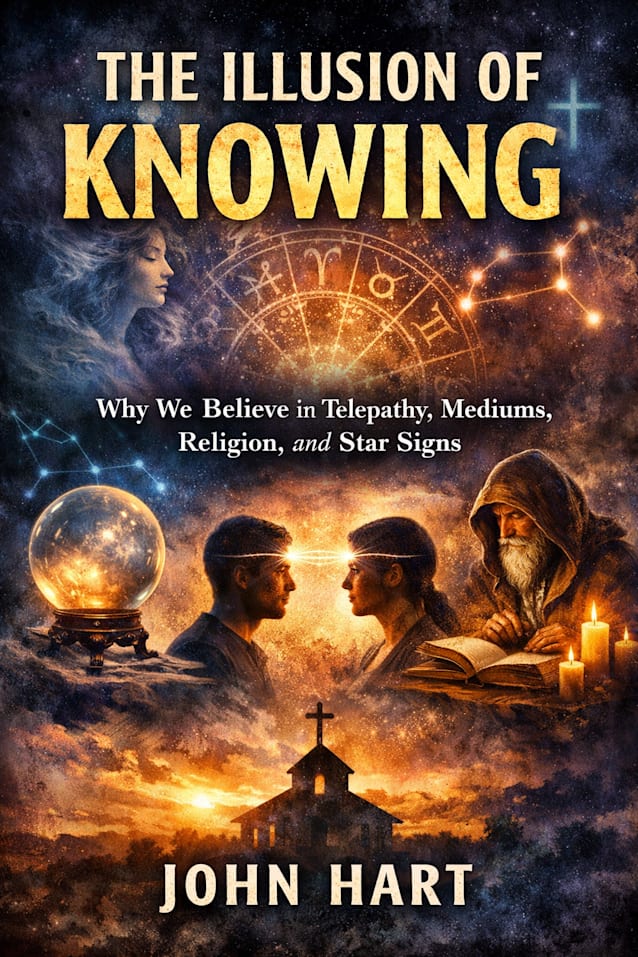
The Illusion of Knowing:
About
There is something profoundly human about the need to make sense of the world. From the earliest days of our species, we have looked at the stars, observed the cycles of nature, and listened for signs in our dreams, not merely to survive, but to understand our place in the vast and often inexplicable universe. This desire to see patterns, to uncover meaning, to feel connected is central to what makes us human. It is the thread that runs through our stories, our religions, our myths, and even our daily choices. Yet, this very need can also lead us to believe in things that may not be real: telepathy, mediums claiming to speak to the dead, horoscopes that seem uncannily accurate, or the idea that a higher power orchestrates events in ways we cannot fully grasp.
This book is an exploration of that tension between human perception and reality, between our longing for connection and the often messy, random nature of the world. I do not write this to mock, belittle, or dismiss anyone’s beliefs. On the contrary, I write with empathy. I understand the comfort that these beliefs can provide, the reassurance they offer in a world that often feels indifferent and chaotic. But at the same time, I bring a sceptical lens, one that asks, “What is really happening here? What does science and psychology tell us about why we believe?” My aim is not to destroy wonder, but to understand it, to illuminate the mechanisms behind the feelings and experiences that seem magical, uncanny, or divine.